Late last year, a long-term client of mine sold her successful chain of beauty businesses in the United States.
For a seven-figure sum.
Good for her, too.
Because when she first came to me nearly 20 years ago, she wasn’t running some glossy, polished, multi-location success story.
She had one struggling location.
She was in trouble.
The kind of trouble most business owners don’t talk about publicly.
Debt.
Stress.
Sleepless nights.
The house mortgaged.
The whole “we either fix this thing or we’re finished” scenario.
She came to me, in her words, begging for help.
So we got to work.
Not on “brand essence.”
Not on “visual storytelling.”
Not on “tone of voice architecture.”
Not on whatever other fashionable nonsense gets served up in boardrooms by people who’ve never had to make payroll from their own bank account.
We worked on marketing that got people to do something.
Call.
Book.
Buy.
Come in.
Come back.
Refer a friend.
Spend more.
That’s direct response marketing.
And in a very short period of time, the business turned around.
Then it grew.
Then it grew again.
Then it became a chain.
Then, late last year, she sold it for a seven-figure sum to a couple of young “corporate” guys.
And today, she sent me a text message that said:
“We were in debt, we’d mortgaged our house… and only crawled out because of you and your marketing!”
Nice to hear, of course.
But here’s where the story takes a turn.
Because when the new owners took over, they cancelled all the advertising we’d been running for the business for years.
Why?
Because it didn’t “fit with the brand.”
Ah yes.
The brand.
That mythical, magical thing that apparently feeds the till, pays the rent, covers wages, keeps the lights on, and convinces strangers to hand over money.
Except, of course, it doesn’t.
Not by itself.
They took all the work we were doing and handed it to another company.
And the result?
The business has fallen off a cliff.
May sales are down a full 30% compared with May last year.
How do I know?
Because the previous owner still has access to the Point of Sale system.
Which means this isn’t a theory.
It isn’t a hunch.
It isn’t me being precious because someone else got the account.
It’s there in the numbers.
Sales down 30%.
In one month.
That is not a “brand transition.”
That is not “market repositioning.”
That is not “short-term softness while we elevate the customer experience.”
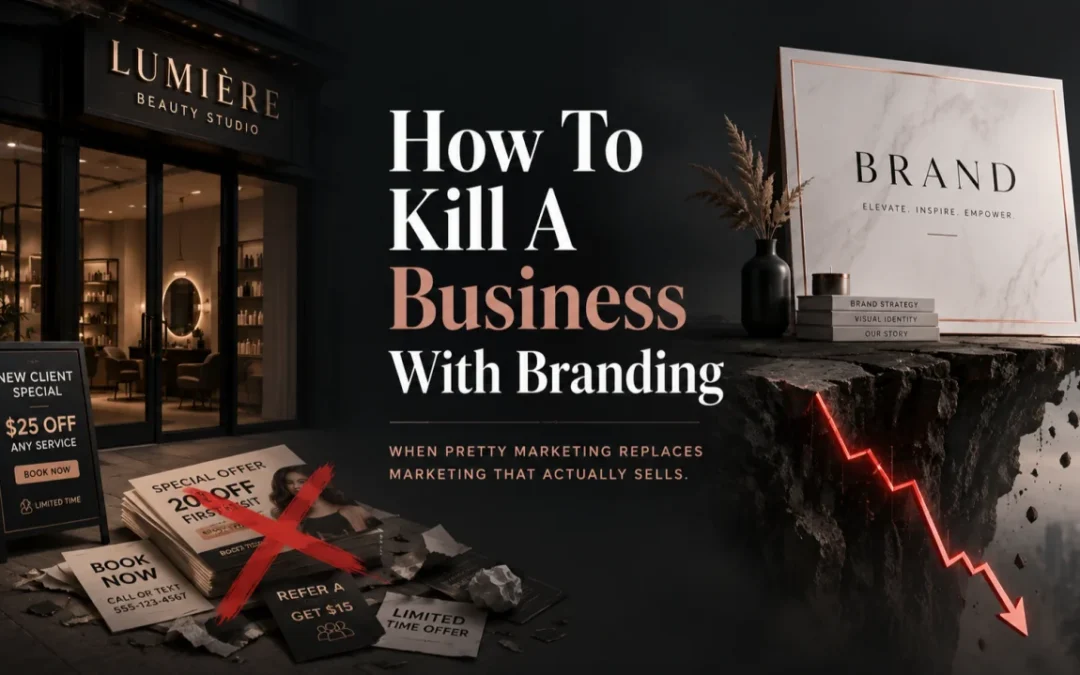
That is a business bleeding money because somebody decided pretty marketing was more important than profitable marketing.
And this is the lesson.
For a small business, direct response marketing is not optional.
It is not old-fashioned.
It is not “salesy.”
It is not beneath you.
It is the engine.
It is the thing that makes the phone ring, the appointment book fill, the website convert, the offer work, the database respond, and the cash register open.
Branding matters, yes.
But branding should be the by-product of effective marketing.
Not the leading strategy.
Your brand is built when people repeatedly see your business making strong offers, solving real problems, showing up consistently, delivering good results, and giving customers a reason to choose you over someone else.
That is how small business brands are actually built.
Not by disappearing up your own backside with mood boards and mission statements.
The big mistake these new owners made was thinking the advertising was just “noise.”
It wasn’t.
It was the machine.
It was the system that had helped take the business from a debt-ridden single location to a multi-location enterprise valuable enough to sell for seven figures.
They looked at the marketing and saw something that didn’t match their idea of the brand.
The previous owner looked at the same marketing and saw the thing that saved her house.
There’s a difference.
And it’s a very expensive difference.
This happens all the time.
A new owner comes in.
A new manager.
A new agency.
A new “brand consultant.”
They look at what’s working and say, “Yes, but we want to make it more premium.”
Or “more elevated.”
Or “less promotional.”
Or “more aligned.”
Then they quietly remove the calls to action.
Soften the offers.
Water down the headlines.
Hide the reasons to buy.
Replace urgency with atmosphere.
Replace persuasion with prettiness.
And then everyone acts surprised when sales drop.
But there is nothing surprising about it.
When you stop asking people to buy, fewer people buy.
When you stop giving people a reason to act now, fewer people act now.
When you replace clear, compelling, direct-response advertising with vague brand fluff, you should not be shocked when the numbers go backwards.
A small business does not have the luxury of marketing that merely “creates awareness.”
Awareness does not pay the BAS.
Awareness does not cover payroll.
Awareness does not save a business when the bookings dry up.
You need marketing that can be measured.
Marketing that can be tracked.
Marketing that makes an offer.
Marketing that asks for action.
Marketing that brings people through the door.
Do that consistently, and yes, you’ll build a brand.
You’ll build familiarity.
You’ll build trust.
You’ll build a reputation.
But you’ll be doing it while also making sales.
Which is rather the point.
The tragedy in this story is that the business already had a working formula.
It had proved itself over nearly two decades.
It had helped create real enterprise value.
Then the new owners came in and treated that formula like an ugly old chair that didn’t match the new décor.
So out it went.
And with it, apparently, went 30% of sales.
That’s one hell of a branding exercise.
The lesson?
Never confuse marketing that looks good with marketing that works.
Never let “brand” become an excuse for removing the very things that make people respond.
And never, ever forget that in a small business, the only marketing that really matters is marketing that makes the business money.
Everything else is decoration.