by Greg Milner | May 11, 2015 | About Us, Australia, The Smell of Success
“Most business owners think the purpose of getting a customer is to make a sale. But smart business owners know the purpose of making a sale is to get a customer.”
Dan S. Kennedy, marketing guru, millionaire-maker, and one of my mentors for more than a decade.
 In any business – and the salon business is no different – the way you think about your position in the market, and how you act on that thinking, is fundamental to your future success.
And the more carefully and deliberately you design your business so that prospects and customers are magnetically attracted to you with a pre-disposition to buy from you, rather than you chasing them, the more successful you’ll be.
My company is no different in that regard. I certainly didn’t dream up the concept. I just sought out the likes of Dan Kennedy and others, studied their teachings, and applied them – haphazardly at first, I’ll admit – to my business.
Many have looked at our success and tried to steal our intellectual property, emulate that success.
Among our Member salons – in more than 15 countries – there has been much curiosity about our business model. So here is how we apply the principles of ‘magnetic’ marketing to our business; why we do it as deliberate strategy…and perhaps the smarter ones among you will be able to study this and ask yourself “How can I apply this thinking to my salon or spa?”
From its earliest days as a spare-room start-up ten years ago, Worldwide Salon Marketing has hired not a single sales rep, made not a solitary telemarketing call, knocked on no salon or spa doors soliciting business, nor cold-called a single salon owner pitching our wares.
And yet the company has been profitable since day one, with a constant stream of salons & spas joining our various marketing, coaching and online programs.
Clearly, the product works. The fact we’ve been wholly or partially responsible for making more money for more salon & spa owners than any other company in the world is testament to that. But a successful business isn’t about product (or service).
It’s about the method by which we attract our customers. We do it by NOT approaching them.
How can this be? Conventional business ‘wisdom’ has it that sales is about wearing out shoe leather, hordes of sweaty salesmen tramping from door to door, armies of telemarketers slaving over banks of phones and computer screens to get appointments, all aimed at securing a meeting in which the prospect finally and wearily signs on the dotted line if only to ease the pain of having their brains beaten in for three hours.
But we’ve never done any of that hard-labour. By deliberate strategy, we have instead forced prospective members to seek us out, jump through hoops to get to us, and pass careful but largely-invisible testing to qualify for membership.
Why make it difficult for our customers to get to us? Primarily, because it increases our value. Pure scarcity marketing, which is what we teach all our Members.
But there is another mainly selfish reason. It’s about the quality of people we attract as Members. Most businesses will take anybody as a customer. And indeed, in the early days I did the same, and quickly learned the folly of such a strategy (or lack of strategy).
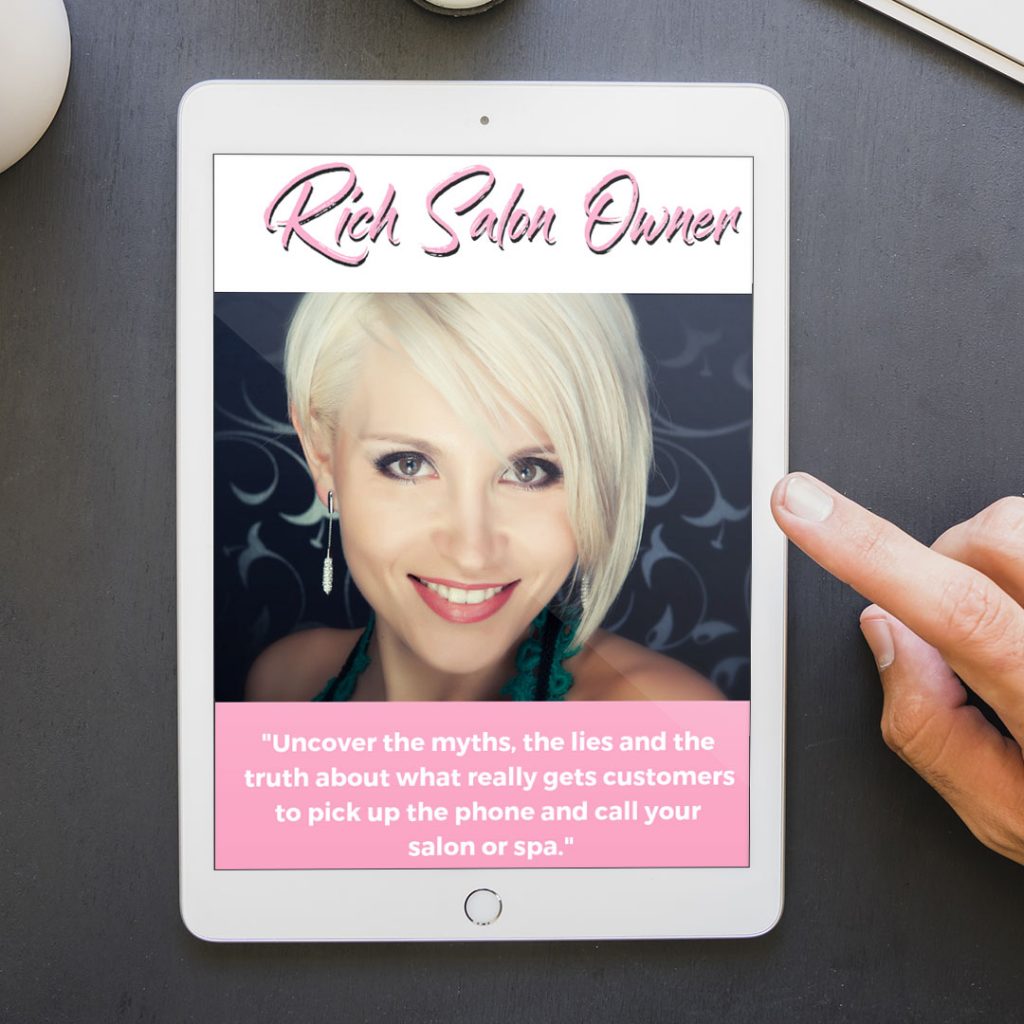
If you look at our main marketing document here, you’ll notice that there’s a LOT of information, videos, testimonials, explanation – detail, detail, detail.
The entire page is deliberate strategy to weed out those who will not apply themselves, who are not willing to study what it takes to be successful, who not only don’t want to learn how to fish, they want the fish handed to them on a plate, preferably filleted and fried, who are only interested in an instant-coffee solution to their problems, a magic bullet they can fire with no thought, application or self-imposed discipline and application.
 It’s selfish on my part because I simply can’t be bothered dealing with people who won’t read, who must be dragged kicking and screaming to the trough, who – if they manage to slip through the net (and a few do) – will sit their copy of Simple Salon Marketing on their salon shelf and expect it to miraculously leap off and gang-tackle prospects as they walk by the shop, with no input or effort from themselves. Who argue with our coaches at every turn, insisting that ‘it’ (the system) doesn’t ‘work’, despite overwhelming proof that it does work for thousands of other salon owners all over the world.
Every salon or spa has ‘project’ clients, those requiring inordinate amounts of tact, diplomacy, cajoling and nurturing far out of proportion to their value to the business. (Definition of tact: making people feel at home when you really wish they were.)
So by deliberate strategy, we’ve structured our marketing and sales process to limit not only our availability, but to elevate the quality of those we choose to do business with.
Eg., when we interview prospective members after they’ve completed one of our surveys, either online or offline via our newsletters, we carefully question them on how much they have read and absorbed the (large amount of) information we’ve published about WSM’s programs, membership fees, rules of membership etc. If the answer is ‘nothing, I just filled in the form’, they are politely but firmly turned away, with instruction to go back and educate themselves, and then come back and talk to us.
No doubt this strict policy of being careful about who we let in has cost us dearly in terms of revenue. But I have no doubt it has also saved us much annoyance and wasted resources attempting to teach the unteachable, and diverted resources from those who have not come to us merely expecting a silver bullet, fired with no effort on their part.
Those of you who are ‘our kind’ of customers will already be studying this model and asking ‘how can I apply this thinking to my business?’
And those visitors to this site who are clearly NOT our kind of customer…well, your eyes would have glazed over before getting this far anyway, and clicked through to somewhere else where the promise of easy success with no effort shines brighter.
by Greg Milner | Apr 20, 2015 | Featured, The Smell of Success
A salon owner once asked me – with a completely straight face – if I could write her an ad that would flood her salon with customers and turn her business into a thriving cash machine. Overnight.
In other words, “give me one perfect off-the-shelf, simple solution to a complicated, multi-faceted, ever-changing and, more to the point, on-going, ever-increasing problem.”
It amazes me how so many people in small businesses somehow expect a single, ‘silver bullet’ answer to a complex problem:
how to get more customers.
Very, very few business owners ‘get’ the complexity and difficulty of the task, the details that matter.

Keith and his new bride Yumi…their wedding was an exercise in military precision
I’ve just returned from a family wedding on a tiny jungle island called Koh Tao in the middle of the Gulf of Thailand, where one of my son Keith married his beautiful South Korean bride Yumi.
At such a remote location, the wedding was a logistical nightmare, requiring more than 18 months of planning. Emails and phone calls went back and forth for month after month. Six months before the big day, Keith flew to Koh Tao to personally co-ordinate the various elements of the event.
Getting the wedding guests committed to booking their flights – from as far afield as Vienna and Brisbane – was an exercise in trying to herd cats.
Depending on where they were coming from, it took guests at least two, often three or four plane rides plus a two-hour boat trip just to get there. Co-ordinating accommodation for 30 people, plus caterers, wedding planners and photographers by remote control in a non-English speaking third-world country was an exercise in patience, understanding and persistence.

Koh Tao – a jungle covered speck in the gulf of Thailand.
The event went off without a hitch, all thanks to my son and his new wife. And it made me think;
It seems to me if business owners put as much thought, planning and attention to detail into their product launches or marketing campaigns, their lives would be so much more prosperous.
But people invest more effort, expend more energy, drive themselves into more of a tizzy over their…Christmas parties…than they do their own businesses. Go figure.
And yet, when focus, energy and attention to detail is turned into a carefully-planned campaign to generate business, much can happen.
Example: Kim Susskind’s Brazilathon Campaign

Just part of the free publicity generated with a carefully planned and executed marketing campaign…
Last year, Noosa salon owner Kim Susskind wanted to generate publicity to promote a planned ‘brazilathon’ – to create a ‘world record’ number of brazilians performed in a single day. Over a period of weeks, I worked with Kim to design a campaign that got her not one, but two front page stories in the local newspaper, radio air time, social media exposure, and a series of emails and text messages that – in combination – produced saturation coverage in her local market.
The result: a new ‘world record’, the talk of the town, and a backlash from competing salon owners jealous of Kim’s new-found fame. (Kim now features as a columnist in the same local paper, further cementing her ‘authority’ as an expert – the ‘go-to’ person in her area.)
Worth noting: this could not have been achieved with a lazy mere email, a single mailbox flyer, a hap-hazard text message, or a thrown-together post on Facebook.
Successful marketing isn’t an event, it’s a process.
Kim’s campaign required planning. But the most careful plans in the world are useless without timely, persistent execution.
 “Give me six hours to chop down a tree and I will spend the first four sharpening the axe.”
Abraham Lincoln
by Greg Milner | Jan 10, 2015 | Blog, Featured
 Years ago I used to work with someone who was full of ideas. No, I mean, many of them were really, seriously good ideas. Okay, some were klutzy, ill-researched mere brain dumps, but there were many that had real merit.
They’d tumble out of this person’s mouth in a torrent, like confetti. At first I was mildly amused, sometimes even interested. But eventually it got to the stage where I dreaded hearing of yet another great scheme, another towering, money-making skyscraper of a proposition.
It wasn’t because I’m a negative kind of guy. On the contrary, I wouldn’t still be in business now if I was the type who stuck a pin in every balloon that floated past my face. The trouble with all these great ideas was just that; they were only ideas.
Without implementation, they were…worthless. I would say to this person “That’s a really good idea. Now, go and get it done.” At which the retort would be something like “Well, I don’t know how/don’t have time/I’m the ideas person…”
And that’s where everything fell in a heap, dissolving away as a lone snowflake melts when it hits the ground. I find this happens in a lot of salon businesses. I call it “Implementation Reluctance.” During a mentoring session with one of our My Social Salon program members recently, I referred to my notes from our previous session, during which she’d excitedly told me about all her marketing plans for 2014, and all the ideas she had.
“So, two weeks ago you gave me a list of strategies you’re going to put in place this year,” I said. “What have you done about this one?” And I detailed exactly what she’d told me she was going to do.
“Oh, actually I got a bit busy…”
Okay, what about that idea you had about competitions?
“Um, well I told one of the girls about it, I don’t know if she’s done anything yet…”
It was much the same dithering for half a dozen other ‘great ideas’. In short, precisely nothing had actually been done. Sometimes, even when fully-equipped with all of the brilliant online and offline marketing tools, advertising templates, processes and systems contained within the world-famous My Social Salon program, it’s sometimes surprising to find salon owners paralyzed into inaction, enriched with excuses as to why they can’t get things done. Now, if this sounds kinda familiar to you, you’re far from alone. According to Harvard Business Review authors Robert Kaplan and David Norton, “…failure rates [for planning implementation] are reported in the 70 to 90% range…”
Here’s the Big Fact:
The ability to execute strategy is more important than the strategy itself.
A brilliant plan without implementation is actually worse than a so-so plan implemented with passion and persistence. And over-analysis is one of the biggest implementation-killers. I see this all the time, salon owners tying themselves into knots of inactivity by trying to second-guess every possible permutation of possible outcomes, even if there’s a minute chance of ‘Situation C, D or E’ actually happening. The Second World War in Europe might well have been over by Christmas 1944, instead of May 1945, if the Allied generals had not so often replaced aggressive action with over-cautious, paralysing inaction. (In fact, the Germans fought better than the Allies almost right to the end. The Allies eventually won only because of their overwhelming superiority of men, machines and supplies, not because of better implementation.)
I’ve lost count of the number of times over the decade since I founded Worldwide Salon Marketing I’ve been approached by ‘entrepreneurs’ (i.e., opportunity seekers) who’ve been excited by the possibilities of licensing WSM’s systems and intellectual property for other non-salon market segments (e.g., chiroptractors, or veterinarians, or landscape gardeners etc etc). No sooner have I confronted them with the size of the task of implementing their ‘get-rich-quick’ scheme – the infrastructure that has to be put in place, the sheer amount of material that has to be written, the online and offline processes – they quickly fade away into the shadows.

Paul Newman in Cool Hand Luke. “What we have here, is a failure to communicate.”
Back in 1967, a young Paul Newman starred in Cool Hand Luke, plating a recalcitrant prisoner who refused to knuckle to the rules, and was punished relentlessly. The chief prison guard made the now-famous observation “What we have here, is a failure to commuuunicate.”
In business, what we have here is a failure to implement.
Here’s how I get things done (implemented). It might help. Presented with a new idea, a strategy, any kind of ‘action plan’, I first write down a comprehensive, very detailed list of what has to be actioned to implement the strategy. Let’s say, for example, that we want to promote a series of education seminars to salon owners.
1) I write down, or print out, a list of our potential attendees – their names, salon names, addresses etc.
2) I (or one of my staff) set down on a calendar the proposed dates for these events.
3) Then we work backwards from those dates, making a ‘timeline’ of what has to have been done by certain days/weeks, for example, venues sourced and booked, deposits paid, speakers alerted etc.
4) The marketing of any product, event or service is actually more important than the product or service itself. So I spend a lot of time working with my team on what has to be put in place to market these events. For example:
a) It’ll need its own website/blog/Facebook fan page. So, who’s going to actually set these up and write the content for them? This is one of the most time-consuming but important tasks of all, requiring a wide range of skills. It can’t be done haphazardly.
b) How are we going to drive traffic to these landing pages/order forms/fan page? Who’s going to do what, by when? All of this goes on the main calendar, and reminders set in the online calendars of all individuals involved, so there are no excuses like “I forgot” or “I didn’t know about that bit.”
c) Print media – eg magazine advertising. Which magazines? What are the artwork/copy deadlines? Who’s going to write and design the printed material, by when? (Again, diarised.)
5) Event co-ordination, ticket sales, name tags, travel and accommodation; allocation of responsibilities.
6) Post-event marketing and product/service delivery requirements.
This is just a partial list – there is much more to it, but it gives you an idea of framework. You can apply this whole process, for example, to any kind of salon birthday event, ‘client appreciation’ evening etc.
 Then – crucially – at the end of every single day, I write a bullet-pointed list of ‘action steps’, things that actually have to be done the very next day. It’s invariably a long list. And here’s a tip: if you ever get to the end of a working day and your desk is clean, every item on your day-list ticked off as ‘done’…then you haven’t put enough things on your list! Success is messy, chaotic, full of loose ends. Neatness and orderliness might be attractive, but it’s full of invisible holes.
(Back to that My Social Salon member above: if she’d done just ONE thing, taken just one action towards implementing her stated marketing strategies in the ten working days since I’d last spoken with her, she would have accomplished ten things!)
As entrepreneur and angel-investor Amy Rees Anderson writes, “Great ideas are a dime a dozen. People who implement them are priceless.”
 Want help with ideas and how to put them into action? Each month, we accept just five new salons (worldwide) into the world’s most comprehensive online and offline marketing & mentoring programs, developed only for salons & spas.
Check out how you might qualify for the famous My Social Salon program here.
by Greg Milner | Sep 16, 2014 | Featured, The Smell of Success
 After more than a decade of coaching and advising thousands of salons & spas around the world on marketing & sales, there’s one question cropping up repeatedly that I simply can’t answer. Not because I don’t understand the question, but because it’s the wrong question.
Typical is this version. It lobbed into my email inbox today from a subscriber in Nicosia. (Look it up. It’s the capital of Cyprus, off Turkey. But it’s essentially the same question I get from Sydney, San Francisco, Dublin and a hundred other places.)
“I need your help, I am opening my salon and I need a good name so that I can make a good logo…”
Kyriakos, I’m here to tell you – and anybody else who’ll listen – when you’re starting a business, the last thing you need to spend your time and energy on is a damn logo. Good grief. In the six-inch-thick “How to Set Up, Market and Run a Super-Successful Salon Business” manual, the appropriate ranking for “Designing a Logo” is approximately Chapter 114.
Picking ‘Logo Design’ as your first, all-important priority is akin to the general sending his troops into battle with the first order of business being the colour of their socks.
So here it is, for Kyriakos and tens of thousands of starry-eyed hopefuls all over the world, many of whom have been inspired into business by the misguided words of encouragement from an aunty of their best friend’s second cousin who said “Oh, you’re so good at facials, you should start your own salon…”
The 10 Rules of Engagement for Would Be Salon Owners (and plenty of others already in the salon business.)

Do you really think even McDonalds would sell a single hamburger if all they did was stick their logo out front?
Rule #1: The Logo.
Forget about the bloody logo design. Outsource it on Elance to a graphic designer in India for 20 bucks. In terms of its value to anybody but you, it’s actual, measurable ability to attract customers to you who are willing and able to give you their money, it’s worthless. There are hundreds of far more important tasks you need to accomplish.
(Need a new name for your business? Go to http://www.salon-business-names.com/)
Rule #2: The List.
As my colleague and chief technologist at Worldwide Salon Marketing, George Slater is often heard to say, ‘the money is in the list.’ That is, building, nurturing and constantly adding to your list of prospects, customers and clients. And I mean a proper list, with full contact details, not just a lazy mobile phone number.
Your database is gold. Having a solid, well-maintained and growing list gives you options. It allows you to reach them in many ways – by email, by SMS, by ‘push notifications’ to your app on their smart phone, and most important of all, by direct mail – yes, that old-fashioned, clunky but still devastatingly effective form of media almost everyone ignores these days.
(But, done my way, almost everybody opens and reads.)
There are lots of ways of building a list of prospective customers, and you should be using all of ’em, but one of the most effective is online search. In its simplest form, it’s some kind of landing page where you offer visitors some kind of reward – a free series of ‘beauty tips videos’, a downloadable report, a free ‘introductory Gift Voucher’, a free sample you pop in the mail to them, to name a few – that potential clients get in exchange for their valuable contact details. In other words, an opt-in form that puts their name and precious contact details straight into a database on your salon computer.
(Effective online name capture is part of what we do for Members of our My Social Salon marketing & mentoring program. Go here to find out more.)
Rule #3: Your USP, or Unique Selling Proposition
Nobody except you gives a toss about your logo, or even the name of your business, except in so far as it tells them instantly exactly what business you’re in. (Hint: resist the temptation to be ‘clever’ or ‘arty’ with your business name. Make it clear what the business does.)
What prospective clients actually care about is ‘what’s in it for me?’ They want an answer to the unspoken question, “Why should I, your prospective customer, want to do business with you in preference to any of a dozen other salons?” And the answer is not “…because we’re really good at what we do.” Work hard, agonize, write lists, spend time and effort identifying things about you, your salon, your location, your advantages, that speak directly to the customer about what’s in it for them. (Clue: make your USP about the customer, her preferences, desires, fears, needs – not about you, the business, how many qualifications you have, the awards you’ve won, how wonderful your customer service is. Sure, they’re all important (kind of) but only as support for a great USP.
Rule #4: Forget ‘branding’.
Branding for its own sake might make you feel all warm and fuzzy, swooning over the compliments showered on you by friends and family about your wonderful colour schemes, pretty posters and wow fixtures and fittings. But relying on pure ‘branding’ to drive customers through your doors with their wallets wide open is an absolutely guaranteed way to send you broke before you start. What I call ‘direct response’ marketing is the only proven, measurable, accountable (over many decades) way for small businesses to spend their marketing dollars effectively and efficiently. At Worldwide Salon Marketing we constantly hear “I spent $150,000 on my logo design, decorating my salon, buying furniture, products, machines etc etc and I have no customers!” But how much on effective marketing? “Er, I didn’t have anything left over for marketing.”
‘Branding’ says ‘let’s put up some lovely logos, expensive ads with pretty pictures and not much else, and hope that if we throw enough mud against the wall, some of it might stick and eventually, people might recognize my brand and come see me.’ You don’t have the luxury of ‘eventually’.
Direct response is what it says – identifying a narrowly-defined target market (your list), crafting an offer supported by your story (with your USP as its cornerstone), distributing that offer as efficiently as you can (using several media, not just one) to as many people in that target market as possible, and measuring the response to that specific marketing campaign.
Rule #5: Be somebody, do something, be everywhere.
 Sir Richard Branson built a multi-billion dollar business called Virgin thanks to his willingness to do things, be places, re-invent himself in a way very, very few people are prepared to do. You may not want to create an empire like Branson, but to succeed in any business, you need to do what your competition is not prepared or willing to do…become the recognised, go-to expert in your field. And that means writing articles, recording videos, getting interviewed, publishing your knowledge and expertise in as many places – online and offline – as you can. Sales coach John Lees used to say “Our knowledge is ours to give, not ours to keep.” You have talent, education, knowledge, expertise that your prospective clients do not. Don’t be shy about it.
(As part of our flagship My Social Salon marketing & mentoring program, we coach and advise salon owners on exactly how to do this. Check out My Social Salon here. But be warned, we don’t take prisoners, and we expect Members do what it takes to achieve success)
Rule #6: Get off the tools
You will never, ever have a real business if it relies either wholly or mainly on you to earn the income. That’s not a business, it’s a job. Or even worse, a hobby. If you want a real business, start it with the end clearly in mind. Ideally, to build a saleable asset – real business equity. At worst, a business you can walk away from, take a holiday in Tuscany for a month, while it runs on ‘automatic pilot’. Yes, that means you must have staff, and you must have systems in place, for all aspects of the business. (Clue: if you ever get a phone call from a staff member asking “Mrs Splonge has complained, what should I say to her?” then your systems need fine-tuning.)
You need systems for everything; stock ordering, retail selling, re-booking, opening and closing procedures, complaints policies, treatment procedures, and most important of all, marketing systems in place that bring a constant and steady stream of new and returning customers through the doors.
Rule #7: What marketing actually is.
Marketing is ‘any and all activity which brings a customer to you who is willing and pre-disposed to buy from you at the price you want to charge.’ Simple outcome, complex challenge. Ray Kroc, the founder of McDonalds, used to say “clean toilets is marketing”. So is a smile, an unexpected small gift, a simple thank you, a hand-written word of congratulations or gratitude, the opening of a door. But too many business owners come to me and ask for a single, one-size-fits-all, set-and-forget solution to a complex problem. “Write me an ad or a sales letter that’ll turn my business into a raging success, and I’ll never have to do any marketing ever again, so I can concentrate on doing the job and running the business.” In the history of the known universe, that’s never happened – for any business – and never will.
Marketing IS the business. You’re not in the beauty business, or the hair business, or the massage business. You’re in the marketing business. Get your head around it, or you’re doomed to fail.
Rule #8: Marketing is a process, not an event.
Not everything you do is going to work. Yet a big mistake almost every salon owner makes is doing one thing, running one ad, sending out one set of mailbox flyers (usually, to too few people), writing a single email, putting all their effort into a single big event three months from now, and expecting a stampede of customers. And, of course, being bitterly disappointed when that one thing doesn’t produce a flood of cash.
Successfully marketing a business – any business – is about doing a dozen, twenty, a hundred things, simultaneously, knowing and understanding that not everything is going to produce great results. The number ‘one’ is the most dangerous number in business. Relying on one of anything – one staff member, one supplier, one customer, one form of marketing (you Facebookers, I’m looking at you) and you’re destined for a fall when that one thing fails, or is taken away from you. In 1997, I spent months working with a major mortgage broking company planning a street parade to generate publicity for a product launch. It was going to be a real knockout. Come the day of the big parade, a Sunday, the entire side of a mountain collapsed all over the ski village at Thredbo in the Australian Alps on the other side of the country, burying 18 people alive. How much publicity do you think our little street parade got? We’d put everything into a single stunt, and it failed through circumstances beyond our control. But that’s Murphy’s Law. Don’t let Murphy run your business.
Rule #9: back yourself.
That means giving your prospective customers the comfort of a guarantee. A strong one, not full of ‘weasel words’. You don’t have to guarantee results, if those results depend almost entirely on the customer dieting properly, exercising a little bit, using the product in the prescribed manner. But you’ve got to guarantee something, to take away the single most important factor that stops people picking up the phone and calling you, rather than your competition. And that is fear of making the wrong decision. Remove the fear, reverse the risk. In all my years of coaching salons on their marketing, those who shouted a strong, money-back guarantee from the rooftops have enjoyed the most success. (And have you noticed? Almost nobody actually claims on a guarantee!)
Rule #10: Meaningful specifics beat meaningless generalities.
Too much marketing is full of fluffy, meaningless words and images. The term ‘anti-ageing’ has been so over-used it’s become a cliche. Does your product or service make your customer look younger? How much younger, in years? If you guarantee not to keep your customers waiting long, what is ‘long’ – 3 minutes and 24 seconds? Seven minutes and 42 seconds? Say so! Be accountable. Few things enrage me more than warm, fuzzy motherhood statements like ‘join us for a night of fun and games’ (what fun? which games??) or ‘relax and de-stress with a one-hour Indian Mystic hot stone massage…’ (Which Indian mystic? Is it an Indian from India, or a Red Indian from North America? How will it de-stress me? Where do the stones come from? How hot are they? Will they burn me? Grrr!)
The more you tell – about you, your service, your customers – the more you sell. In marketing, less is not more. More is more.
 NEED HELP WITH THIS STUFF? Members of our My Social Salon get all this – and a LOT more. It’s an exclusive, elite group of salon owners all over the world who want their businesses to work for them, not the other way around. And, if you qualify, you could get a 30-day Money Back Guaranteed Test Drive of the entire system, including the one-on-one coaching support.
by Greg Milner | Aug 5, 2014 | Featured, Marketing Products, The Smell of Success
 It always surprises me how little so many salon owners know about their own businesses. Particularly, some absolutely crucial numbers. In more than a decade of consulting to salons, I almost always get a bemused silence when I ask a salon owner for one vital piece of information.
“How much is an average customer worth to you in say, a year?”
It’s a question that goes back to an old saying in marketing: “Most business owners see the purpose of getting a customer is to make a sale. Smart business owners realise the purpose of making a sale is to get a customer.”
Most salon owners fall into the former category. They can, with reasonable accuracy, deduce the size of a per-visit spend by an average client, but few seem to have made the connection between the one-off sale, and the concept of “Lifetime Client Value.”
Do you know what an average customer is worth to you in a year? Do ya? Really??? Because if you don’t, you’re fighting a losing battle wearing a blindfold, with both arms tied behind your back.
My question about ‘lifetime value’ versus one-off sale value is usually met with a blank silence because most seem to look no further than next week’s appointments, let alone next year. Yet, when you know such a crucial business ‘key performance indicator’, you can see your database of client records in a completely different light.
Looking at your list of ‘missing in action’ clients suddenly becomes an exercise lit by flashing dollar signs. Imagine this: of your entire database of say 1,000 client records, you discover that only 300 of them are so-called ‘active’ customers. That is, with a reasonable degree of accuracy, you can be pretty confident that in any two month period you’ll see all of them.
Here’s where many owners of service businesses tie themselves up in an ever-tightening knot. Instead of ‘mining’ that database for gold nuggets, they ignore it, and focus frantically on the acquisition of ‘new’ clients – an expensive, time-consuming and often frustrating exercise.
So let’s do some numbers. Say you have 500 clients you haven’t seen for three months or more. In all honesty, if you haven’t seen someone in three months or more, they’re either dead – there’s not much you can do about that – or they’re so ‘cold’ as to be barely registering a pulse. But…and here’s the major difference between these people and all the brand new clients you spend every waking hour trying to attract – you have their contact details. (Well, you do, don’t you…don’t you???)

Letter #1 of the famous Rupert the Dog series…the ‘lost client’ retriever for salons all over the world
Even the most haphazardly-organised salon collects mobile numbers. Some might even have email addresses (although the value of email as a first-strike marketing media has been so degraded in recent years that as a stand-alone method of delivering a message it is almost useless.)
And the really serious business owners, those who treat their salon as a proper business, rather than a mere job – or worse, a hobby – have meticulously built a comprehensive database containing not only phone numbers and emails, but real, actual, old-fashioned physical mailing addresses.
Back to the numbers.
Let’s say you’ve done your numbers – if you’ve read this far, your fingers should have been dancing over your calculator well before now – and you’ve worked out that a regular, long-term client is worth $1,000 to you in a year. If you were to send a compelling offer to those 500 former or one-time-only clients, using a combination of media (phone, email, hard-copy letter), and that offer resulted in say, 30 of those 500 re-visiting the salon to redeem that offer…and you were able to turn 20 of those 30 into regular, long-term clients, guess what? By that single, well-executed marketing campaign, you’ve just given your business an annual income injection of…
$20,000!
And what if you were to repeat this exercise say, three times a year?
(And here’s a thought: next time a new customer walks through your front door, are you going to see $150 stamped on her forehead…or $1,000 stamped on her forehead? Makes a big difference in how you view and treat each new visitor, don’t it!)
There is overwhelming evidence that this process produces results. For years, our Member salons have been using a famous sequence of client letters now known as the “Rupert the Dog” series, in combination with SMS and email follow-up, to ‘Raise the Dead’ from among their lost-client database.
In the UK, Hannah McEnteggart is a typical example:
[cf]hannah[/cf]
 You can get these exact same letters as part of the two-volume Salon Marketing Starter Pack. Download the Starter Pack instantly, and get not only those winning Raise the Dead letters, but a whole bunch of other tested and proven salon marketing templates and strategies.