Online ads that work – sometimes TOO well.

Want help with your digital advertising? Click here for more info!

You can post like a man (or woman) possessed in social media. You can network like crazy, you can post videos on Tik Toc till you’re blue in the face.

You can run yourself ragged using all these ‘free’ platforms in an effort to generate leads and sales for your business. But if you’re really serious about marketing your business, then sooner or later you’re going to have to use PAID advertising.

And if you’re trying to attract new customers, there are really only TWO digital platforms worth spending a lot of energy on; Google, and Facebook/Instagram. 
You can post like a man (or woman) possessed in social media. You can network like crazy, you can post videos on Tik Toc till you’re blue in the face.

You can run yourself ragged using all these ‘free’ platforms in an effort to generate leads and sales for your business. But if you’re really serious about marketing your business, then sooner or later you’re going to have to use PAID advertising.

And if you’re trying to attract new customers, there are really only TWO digital platforms worth spending a lot of energy on; Google, and Facebook/Instagram. 

Google or Facebook ads?

For the purposes of this exercise, I’m going to concentrate on Google.

Because Google is the default go-to platform when people are searching for a product or service in their area.

Unless you really know what you’re doing in the back end of the Google ads dashboard, you can waste a lot of money and time. Yes, it’s complicated, it’s easy to make mistakes, and mistakes can cost money.

But if you get it right, you can really knock it out of the park.

The first metric you want to pay attention to is something called the Click Through Rate, or CTR.

That’s the number of clicks the ad gets as a percentage of the number of times the ad is shown when people search.

Now, according to Google’s vast knowledge-base, the average CTR for all the billions of ads shown every day is somewhere between 4% and 6%.
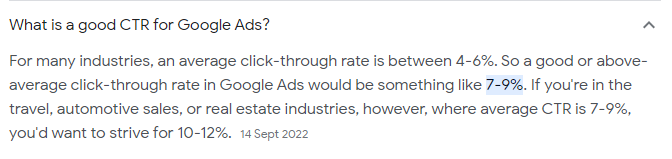
This is the AVERAGE click through rate for Google ads

So how would you like to get a CTR of twice or even three times that? 

Here’s an ad my team devised for a new gutter-cleaning business: 
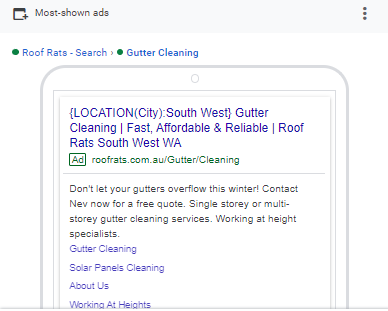
This is a Google ad that's working well

In a little over 3 weeks since the ads started running, they’ve been shown just under 300 times, and 52 people have clicked on them and gone through to the business’s website. 

That’s a click through rate of nearly 18%, three times the Google average.  Each click has cost the business $7.68, which is fine, because each sale made is worth many hundreds of dollars.  
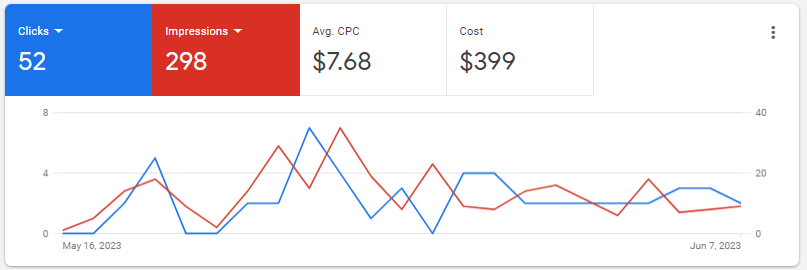
Here's an excellent Google ads result.

Here’s another example. This is a liquid waste management company. One of their main revenue sources is pumping out septic tank systems. 

Google ad that gets great results

Their average CTR for the past month is 10.66% – pretty good. But some of their keywords are producing huge CTRs, up to 44%:
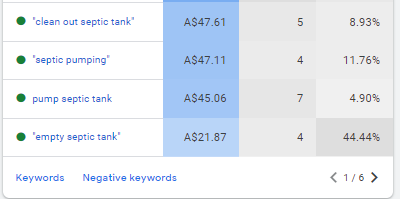
best performing keywords

Of course, there’s a LOT more to it that just click through rates. What you’ll pay for each click depends on many variables, for example how much compeititon you face in your target market.

Another crucial thing: 

Simply setting up a series of Google ads and sending clicks to the home page of your website and hoping for the best isn’t really going to cut it.

It’s usually best to have a dedicated landing page designed specifically to take traffic from the Google ads.

For example, the ads for the liquid waste management company above send people to a specific page on their website that ONLY talks about septic tanks. You can check it out here: https://shepvts.com/septic-tank-pump-out/

Greg and Digby the Australian Cobberdog
Greg Milner signature

Need help with your digital advertising? Click the button below and book a FREE one-on-one Zoom call with Greg.


 

The right way, and the dumb way to market anything

The right way, and the dumb way to market anything

In my home town, Dunsborough, a coastal holiday destination in the south-west of WA,  there’s great community concern about developers and their plans to build multi-storey blocks of million dollar apartments. Both the townspeople and the local council are against it. Recently we held a public rally to demonstrate support for the council’s proposed amendment to limit heights to three storeys or less.

No fewer than 1,000 people turned up at that rally, a huge turnout considering the entire town’s population is less than 9,000.
Marketing to attract a crowd
The reason so many turned up was simple: a well coordinated, multi-media marketing campaign launched ten days before the event. We ran ads on Facebook and Instagram, volunteers delivered thousands of hard copy flyers, we had mainstream media coverage and an ad in the local paper, as well as widespread viral comment generated on Facebook.
People turned up with home-made posters, we had the local radio station board, as well as TV coverage.
The rally had a big impact. It drew comment from the state Minister for Planning, and wide support from the local council.
It took an enormous effort, with the resultant big payoff.
huge crowd at rally
Yet it’s remarkable how many businesses never figure this out. 
Last month, a development company proposing to turn acres of local farmland into housing estates decided they would do the right thing and hold a ‘community consultation’ session about their plans.
They sent an email – one lazy email – to 1,000 people announcing the date and location for the information session. That was ALL they did.
On the day, just ten people turned up. Ten. And self-righteously, the developer claimed they’d done their job, and the community clearly wasn’t interested. No, they didn’t do their job. If they had, they would have had people queuing up.
Here’s the lesson: 
If you want to make an impact, you have to get the attention of the market.
And that means taking Massive Action.
And repetition.
A single email just doesn’t cut it. More than half will end up in junk folders. Of what’s left, 80% will be ignored. And most of the small number of people who actually read the email will have forgotten about it within half an hour.
No follow-up, no result.
Successful marketing isn’t about doing one thing – one email, or one Instagram post, or one text message, or one of anything, for that matter, then sitting on your hands and expecting a stampede of customers beating down your door.
Neither is it about doing one thing now, waiting a month and doing something else next month.

Success requires a hundred different things, all done simultaneously.

In business, less is not more. More is more.
WANT HELP TO CREATE A BUZZ…MORE CLIENTS…A STAMPEDE? 
HIT THE BUTTON BELOW AND BOOK A FREE
Scammers, Liars and Thieves Online

Scammers, Liars and Thieves Online

I don’t email much these days, mainly because people get enough junk trying to sell them something. And to be fair, some of it is good stuff. But sometimes I’m compelled to write when something as egregious as this pops up in my own online world.

I suppose there might, just might, be a tribe of pygmies somewhere deep in the Amazon forest that hasn’t yet been the target of online scammers.

But for the rest of us, it’s a daily battle to decipher truth from fiction. And dangerous fiction at that.

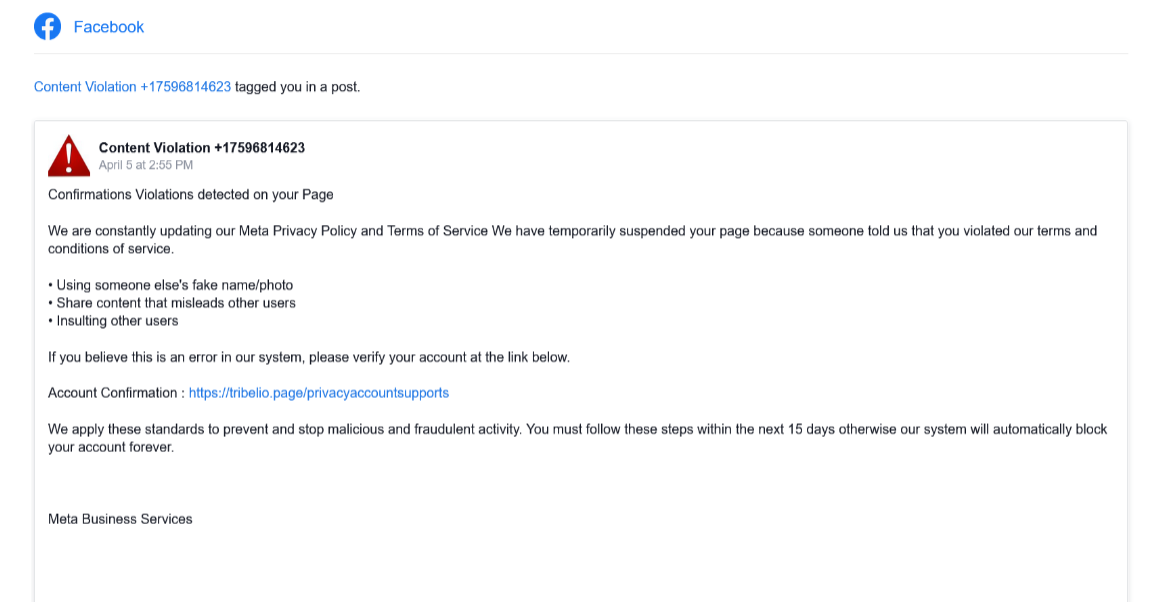
So here’s a head’s up: if you get a notification from Meta in your Facebook account that looks like this, DO NOT CLICK ON ANY LINKS!

Have you received this scam on Facebook?

This screenshot was emailed to me this morning by one of our long-term members in Queensland, alarmed that her Facebook post wishing clients a happy Easter had somehow violated Meta’s policies.

It was suspiciously similar to “alerts” that had popped up in my own feeds, as well as those of several other close colleagues, so I ran it by Worldwide Salon Marketing’s specialist social media guru, Samantha Buckley.

“Definitely a scam. Delete and don’t click!” she said.

These frauds look legitimate because they use a post on a Facebook Page as the landing page for the phishing scam, which then redirects users to another site.

Another one looks like this:

They are trying to steal your identity, and ultimately, your money.

Be cautious. Don’t click on any links unless you absolutely, positively KNOW it’s legitimate.

And if you need any help with any Facebook, Meta, Instagram or other social media challenges, get in touch. We can assist, and set your mind at ease.

And don’t click any suspicious links this Easter!

Click here to Book a FREE 30 minute ZOOM strategy session in Greg’s calendar! 

Greg Milner, Founder, Worldwide Salon Marketing

Greg Milner, 
Founder, Worldwide Salon Marketing

Puppy Love – How to Sell on Emotion, Not Logic

Puppy Love – How to Sell on Emotion, Not Logic

Digby the Australian Cobberdog

About 18 months ago, the Milner household acquired a new member; an Australian Cobberdog puppy we called Digby, after my late father.

He rules our life, tells outrageous lies, and steals everything that’s not nailed down. But of course, we adore him. It’s hard not to fall instantly in love with a puppy.

There’s an old saying in marketing; if you wan to sell an expensive, ‘luxury’ product, sell on emotion, not logic. And there’s no wallet-opening buying decision more emotional than looking into the eyes of a cute pup.

6 weeks old and super cute

Digby came to us from Western Australia’s only breeder of Cobberdogs, Deb Reuben’s Alkira Australian Cobberdogs in Margaret River. Digby’s sister Daisy had given birth to six girls, they’d be ready to go to new homes in a few weeks, and Deb had no buyers lined up.  Since we already manage the marketing for another business of Deb’s, she approached us for help. These puppies would be ready for new homes in just three weeks

My gun digital marketing specialists took over. Within days, Deb had a flood of inquiries, deposits paid, and more coming in. 

Here’s how that happened: 

First, I told Deb she must record a short video with the pups. I wanted this for a landing page, to take inquiries from a Google ad campaign we were about to set up. 

By the following day, we had that video:

Next, I told Deb to get testimonial videos from owners of earlier puppies she’d sold.

Here’s just one of them:

Using those videos, including one from me and Michelle with Digby, my team built a landing page to take inquiries.

Go here to take a look at that page.

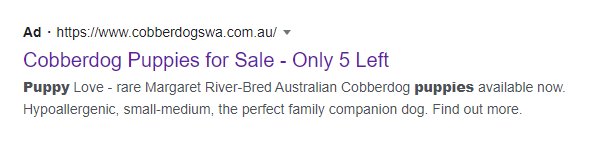
Once the landing page was ready to take traffic, our digital advertising specialist Golda created a targetted series of Google ads. They look like this: 

Google ad for the puppies

Within days, Deb’s inbox was filling with inquiries like this:


From Ursula in Shoalwater:

From Ursula in Shoalwater:

I am very interested in your breed and would love to talk to you about a puppy. I am in touch with a Labrador breeder and was doing some research and came across the Australian Cobberdog I am 52 live in Shoalwater I haven’t had a dog for a while as I was doing a lot of travel … I am ready for a dog again and would like to train it to be a therapy dog – I have already looked into the training in Melbourne. But even if we don’t go that route I am VERY interested in your puppies and the breed.

From Teena

From Teena

I am very interested to know if any of the puppies are still available and if so when we could view them. 

Want help with your digital marketing? 

Book a discovery call with Greg here!