This might just be the most important few paragraphs you read this week, this month, or even this year.
It was sparked by a converstion with a brand new WSM member, who called shortly after the courier knocked on her door to hand over her Essential Salon Owner’s Marketing Toolkit®
This salon owner was clearly overwhelmed by the task ahead of her. “There’s so much material in the Toolkit, I just can’t get my head around what to do first,” she wailed.
(My immediate thought, left unsaid, was ‘maybe we’re giving Members too much material’. But then, how do you eat an elephant? Same way you eat a hamburger, one bite at a time.)
So I told her to take a deep breath, and took her through the only THREE things she needs to concentrate on. “Once you GET this,” I said, “everything else becomes easy, logical, simple.”
When we take on a new Member salon into our flagship marketing & mentoring program, My Social Salon, we work on three main areas, and here they are:
1) MESSAGE
2) MARKET
3) MEDIA
First, under Message: what do you say to your past, present and future prospects, customers and clients that is magnetic… that cannot be ignored…that must be responded to. In other words, what is your
USP – Unique Selling Proposition
Most salon business people – and this applies even MORE to big, dumb companies who pay advertising agencies a fortune in shareholders money – make the mistake of believing that some cutesy slogan is their USP.
Eg., here are some slogans used by three of America’s biggest advertisers:
1. We’re with you.
2. That was easy
3. The stuff of life.
Do these bring instantly to mind the name of the company? Nope, vague, meaningless drivel, all three of ’em.
Here’s what’s instructive: these slogans could be used by almost any company on the planet, with about as little impact. As Dan Kennedy writes in a recent article “…if anybody and everybody can use your USP, it ain’t one…”
I’d be a rich man indeed if I had a buck for every time a salon owner told me “Our USP is ‘we give our clients great service’….”
Put your USP through this test: is it a GREAT answer to the question, ‘why should I do business with YOUR salon as against any of the others?’
If not, go back to the drawing board. Take some of the truly great USPs as a model, lay them down next to your USP, see how they compare.
Does yours do for your business what Tom Monaghan’s did for Dominos Pizza? “Fresh, Hot Pizza Delivered in 30 Minutes – Guaranteed”…?
Does it answer the question like Federal Express answered with “Absolutely, Positively Overnight.”
Let’s say you’ve crafted a great message with a terrific USP at its core, next problem: your MARKET.
Who do you deliver that great message to – and deliberately, who do you exclude from it – do you do that effectively, efficiently with little or no manual labour, are you smart about this or are you simply throwing mud against the wall?
When asked ‘Who’s your target market?’ most salon owners will say ‘Er, all of the adult female population within a 5 mile radius.’
Terrific. If you want to send a postcard once a year to all adult females within a 5 mile radius of your salon – hardly an intense, focussed campaign – what’s your budget have to be? Um, $50,000. How much have you got? ‘Uh…600 bucks.’
Problem. Somehow, preferably by science, you have to shrink your target market to a small, carefully-selected list of the best prospects so that your marketing efforts are concentrated for maximum effect with minimum expense. Jump up and down in a puddle, not the ocean.
And third, the MEDIA.
Having chosen your target market and crafted the perfect message to that target market, what MEDIA are you going to use to deliver that message to that market?
(If you haven’t twigged to this already, once you’ve figured out your perfect target market, and the message to send to it, the media tends to choose itself).
So there.
That’s it in simple terms. Message, Market, Media.
Get those things right, the rest almost automatically falls into place.
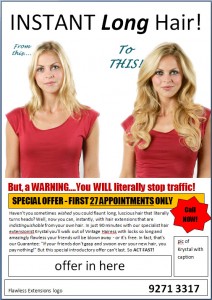
Hair extensions are one of the most profitable services for any salon. But you can’t simply post a glossy picture and hope for the best. Like all direct response marketing, it still needs to be accompanied by a compelling OFFER, and reasons to call you NOW (eg, scarcity, limited to the first X to call etc)
This template allows you to insert your own details, along with your offer, guarantee, scarcity etc.
You can use it as a mailbox flyer, turn it into an image for Facebook and Instagram, and upload it to your own website.
NOT A MEMBER? Get this – and hundreds more done-for-you, proven salon advertising and marketing templates as a Member of Worldwide Salon Marketing. For a ridiculously small price, never again sit in front of a blank computer screen wondering what to write!
How to sell salon memberships – My Salon Success magazine
“How to sell salon memberships that bring in clients and cash up-front”…latest issue of My Salon Success magazineout now!
Just this morning, one of our Member salons in Noosa, Queensland told me she had already pre-sold $9,000 worth of memberships to her clients – and they don’t even go on sale till July 25.
There’s a whole new issue of My Salon Success magazine, and it’s all about selling memberships.
You can view the magazine on your iPhone, iTouch and iPad. (We are just updating the Android version and it should be out soon – watch this channel.)
If you have ever wondered now to sell memberships in your salon to raise cash and lock your clients into coming back you need to read this Issue.
Click on this linkand you’ll be taken straight to the Magazine. You can subscribe for free and get this and 16 other Issues.
Recently, a relatively new member of Worldwide Salon Marketing conducted a marketing campaign in a little outback country town where her tiny two-person salon is located.
When she released the promotion for sale, she was astounded when she collected more money in three days than she normally takes in three weeks.
How? Because she’d discovered the single most important ingredient a business needs to bake a successful cake.
If you could have only one significant advantage over your competitors, what would you want it to be?
A better mousetrap (product) than your competitors? . History is littered with ‘better’ products that sank without trace. (If you’re old enough, you’ll remember the VHS vs Beta home video wars of the early eighties. Sony’s Betamax version was perceived to be technically a superior system. But JVC’s VHS torpedoed it in the marketplace.)
Perhaps a much slicker system for building and delivering that improved mousetrap? Maybe better customer service?
All of those advantages might help, but they’re not the ‘killer ingredient’. Many business owners ponder this question, and rarely come up with a compelling answer.
Yet there IS one key advantage that’ll help a business out-perform its competitors, no matter how superior their products or services, regardless of more efficient delivery systems, in spite of a rival having flashier premises, big-budget TV ads and a squadron of salesmen wearing out shoe leather.
And that killer advantage is…a starving crowd.
The late and legendary American direct response copywriter Gary Halbert first talked about the concept back in the 1970s. In a classroom exercise, students would get to pick their favoured competitive advantage in a hypothetical hamburger stand. Some chose a finer quality meat, others would copy McDonald’s system of cooking and serving the food.
After all the students had chosen their advantage, Halbert would ask first and foremost for…a starving crowd.
So who (and where) is your starving crowd?
Some crowds can be simply found. Fans at a football game will buy thousands of meat pies and cans of coke.
A ‘starving crowd’ for a dentist is anybody with a broken tooth. I was part of a starving crowd a couple of years ago when, on the day my wife Michelle and I were due to fly out for a wedding in Bali, our hot water system crapped out…with a house-sitter moving in the next day.
It was a Saturday afternoon. I had to find a plumber who could replace the system that day. I was starving for a solution. I found one, at last. It cost me $2,000. I paid without a whimper. I was grateful.
Some starving crowds have to be created. That’s what our salon owner at the beginning of this story did. For weeks before her sale, she used all kinds of media – flyers, text messages, emails, posters and more – to create the crowd, and hold it back until the day of her sale.
Which, on a much larger scale, is what the world’s most valuable company has been doing for years. For months before releasing a new phone or other gadget, Steve Jobs used secrecy to generate hype, buzz and demand. By the time the new product was released, starving crowds were literally queued up outside Apple stores all over the world.
How to find your starving crowd.
People don’t care about your product. (Nobody really cares about Apple’s products. But they buy Apple’s latest products because Apple has cultivated the concept of ‘cool’ among its disciples. It’s cool to have Apple’s latest gadget. My iPhone 4 still makes and receives perfectly clear phone calls. But it’s so last decade.)
So shift your focus from your precious product or service, and turn it to finding (or creating) groups of people who need solutions. What pressing need or desire do people have that your products or services solve? And what can you do to identify and find those people?
It’s almost never about selling to everyone. (The White Pages is not your target market.) It’s always a process of identification.
Hint: as a start to this process, look at your own website. Does it have any kind of device to capture and collect the names and contact details of visitors? Most of the people visiting your website are interested in what you have to sell. They’re part of your starving crowd.
Salon Marketing tip: how to be different, not better
Air travel has become so routine these days, few regular flyers (like me) pay much attention to those same-same safety videos the airlines play on the overhead screens just before take-off.
Look around the cabin, and you’ll see a sea of heads buried in magazines or books, while the flight attendants stare stonily down the length of the cabin, clearly as bored with the whole ritual as the passengers.
But in New Zealand, they do things differently.
[cf]AirNZ[/cf]
On my last flight down to Queenstown, there were hoots of laughter at Air New Zealand’s brilliantly innovative and hilarious new in-flight safety video.
With tongue firmly in cheek, the company uses a sharp wit combined with the country’s borderline-insane adoration of anything to do with the national All Blacks rugby team, to focus passengers’ attention on safety-with-a-twist.
There’s a lesson here.
Being boring in your marketing is the only real sin. But how do you make the commonplace stand out? In their terrific book ‘Made to Stick’, authors Chip and Dan Heath write case study after case study on simple ideas that rose above bland, every day ordinariness.
Air New Zealand looked for, and found, a way to get their customers to focus on an important, but routine safety message, by creating a ‘sticky’ idea. The lesson is simple: look around at what all your competitors are doing. Now look at what you’re doing. Is it the same, or is it different? If the same, what can you find that turns the common into the uncommon, the ordinary into the extraordinary?
Leo DiCaprio as Jordan Belfort in The Wolf of Wall Street
Leonardo DiCaprio is in line for an Oscar for his performance in Martin Scorsese’s new film The Wolf of Wall Street. DiCaprio plays the real-life Jordan Belfort, a morally-bankrupt, cocaine-sniffing New York stock swindler who made ripping people off an art-form, and went to jail for it.
I’ve read his self-serving autobiography. It’s repugnant trash.
He still owes $100 million to his victims, a minor oversight Belfort and his admirers tend to underplay as he tours the world making millions more by telling anybody who’ll listen (and pay) how he ‘saw the light’ in prison and became a reformed, hand-on-heart motivational speaker, actually lecturing already-good (but gullible) people on how to lead a better, more fulfilling life.
Good grief. The man is a manipulator, no more deserving of admiration than Ponzi-scheme fraudster Bernie Madoff. The only difference is that Bernie’s still in jail, presumably watching Belfort’s activities with envy.
The catalyst for this line of thought is a recent Facebook post by master copywriter Pete Godfrey on the difference between persuasion and manipulation. At its heart, the difference is intent.
Most marketing in the hair and beauty industry is so bland, uninteresting, completely lacking in passion (for whatever service or product is being pitched) it seems as if the intent is to put readers to sleep. Yet, over some of the advertising strategies and ideas we provide Member salons in our My Social Salon program, I’ve been accused of making it look manipulative.
As Pete writes,
“If what you are selling is crap, and you know you are ripping people off, then your sales message is manipulation, right? If you honestly believe in your product, and it actually IS a good product, and you know damn well it will improve your customer’s life, then you owe it to yourself and to your customer to pull out every persuasion tip you can muster to get the sale.
Because it would almost be a crime if your customer didn’t buy!”
A recent example; in a coaching session with a Member last week, she was bemoaning the poor results of a promotion for her ‘enzyme skin peel’ treatments. I asked her how she described the treatments in her promotion. She said “enzyme skin peels.” Yawn. But how do you describe it to a client when you’re face-to-face?
“Oh, I get excited, I can’t help it, I tell them it’s like a tiny PacMan, chewing away at all those dead skin cells and leaving her skin absolutely glowing and flexible, moist and fresh. It really does feel ten years younger!”
I didn’t say anything for a few moments. Then, “Do you see the difference?” After a pause, she said
“Um…I guess I have a lot to learn about selling something.”
According to Pete Godfrey,
“That’s the kind of mindset I get myself into every time I write copy. It’s like I’m writing a letter to a loved one, maybe my brother and he’s dying from some strange weird disease, and what’s happened is I’ve come across the cure, but no one has heard of it, the doctors say it’s a phoney, and everybody is in my brother’s ear telling him not to try this new wonder-drug; but… it’s my job to convince him to try it. This is the kind of pull-out-all-the-stops attitude YOU must have as well when writing copy that sells. Get passionate. Get excited. Then it’s not manipulation, just damn good persuasion.”
He’s right. If you truly believe in what you’re selling, sell it hard. You do nobody any favours by hiding the benefits of your product or service behind a bland, say-nothing mere label like ‘enzyme skin peels.’ If your intent is honest, then shout from the rooftops.
Few things are more dangerous than a bad person with good people skills. History abounds with them, from Adolf Hitler and Joseph Stalin down. But in business, there is nothing more powerful, more persuasive, more compelling than a promoter with good intentions who believes passionately that what he or she is selling is of genuine, ground-breaking benefit to the consumer.