Rupert the Dog…famous for retrieving ‘lost’ clients back into the salon.
How much ‘hidden’ revenue are you leaving uncollected, just sitting there, just for the sake of asking?
For Queensland salon owner Anita Clements of Twisted Desire hair salon in Corinda, it amounted to no less than $12,000. And all she had to do was ask for it.
Two weeks ago, Anita signed up for a two -week free Test Drive of the popular ‘Lite’ salon marketing program. She downloaded a series of special, carefully written letters, and quickly edited them to suit her salon’s offer.
Last week, she sent the first letter to just 54 of her ‘missing in action’ clients. Ones she hadn’t seen in a couple of months or more. Within a couple of days, 6 of those clients had phoned to book appointments.
Today I asked Anita how much each of those clients would be worth to her in a full year.
“Well, I’ve never looked at it like that,” she said, “but I guess say $200 a visit, say 10 times a year….”
Her voice trailed off as she mentally did the sums. Six clients, spending roughly $2,000 a year each, and she’d suddenly injected $12,000 annual revenue into the business.
But it gets better.
“The clients were telling me they were so amazed by those letters, they were leaning over their backyard fences, showing them to their neighbours!” says Anita.
Letter #1 of the famous Rupert the Dog series…the ‘lost client’ retriever for salons all over the world
All for the sake of a few envelopes, a letter, and some stamps. And that’s before she sends out Letter #2 in the series, to the 48 who didn’t respond.
Those letters are the famous ‘Rupert the Dog’ series, one of the better known of our templates to hundreds of our Worldwide Salon Marketing salons all over the world. For many of those salons, Rupert the Dog has been responsible for bringing back as many as 40% of ‘lost’ clients. If you could get even 20% of your lost clients back, at say just $1,000 a year…well, do your own sums.
Here’s a handy tutorial video put together by Chris Sanders of WSM New Zealand on exactly how to use these letters to bring back your ‘missing in action’ clients:
[cf]RUPERT[/cf]
As the owner of a company which builds and maintains websites and online marketing systems for hundreds of salon & spa businesses, I get a LOT of questions thrown at me from salon & spa owners totally confused about what matters online.
And that’s understandable. Online marketing is part science, part alchemy, practised in a long, dark tunnel populated by geeks who communicate with each other – and with those who pay them – in convoluted technocrat-ese almost entirely incomprehensible to normal people.
I employ such people, and over the years have learned some of their language. So, in my role as interpreter, I offer the following, in plain English.
What’s Your ‘Most-Wanted Response’?
Okay, so you have a website. For many business owners, that’s where their ‘online marketing’ strategy starts and ends. And it’s a long, long way short of what’s required. You need to ask yourself some ‘non-techie’ questions, and have some clear-headed answers, to questions such as:
1) What’s your website for? If its purpose is purely to look nice and impress your customers, that’s fine. If its purpose is to attract customers, that’s a different story. There is absolutely zero point in spending money building a flash looking website your prospective customers can’t find in a Google search. (And don’t make the mistake of deluding yourself into thinking ‘they’ll easily find it when they search the name of my business.’ They’re not looking for the name of your business, they’re searching for the product or service you’re selling!)
That brings me to one of the darkest arts, SEO or ‘search engine optimization’. It’s largely a manual, tedious, time-consuming (therefore expensive) and highly-specialised process involving technical expertise and up-to-date knowledge. And Google’s rules change all the time. It’s like trying to change a wheel on a moving car.
(And a warning: if anybody approaches you and promises to ‘get you top ranking on Google, guaranteed’, run a mile. Nobody can guarantee that, except Google.)
2) Is your website mobile responsive? 90% of people these days use their smart phones to search for products and services. If they find your website and it’s not configured to fit a small phone screen, it’ll be too hard to read, and they’ll go elsewhere.
3) Can they easily find your phone number? Let’s face it, for most businesses, the most wanted response is an old-fashioned phone call. Yet when I visit many business websites, I gouge my own eyes out with a sharp spoon in frustration at trying to find the damn phone number. It’s often (stupidly) buried in the depths of a ‘Contact Us’ page. Put your phone number – preferably ‘hot’ so it’s click-to-call – right at the top of every page on your site. Don’t make it hard for people to call you.
4) What about all the people who visit the site and don’t pick up the phone? Unless you have a way of capturing their contact details so you can market to them later, you’re wasting an awful lot of hard-earned traffic. The best way is offering some kind of free download – a guide, special report, gift voucher, video or what have you – in exchange for their contact details. Even better, make sure those details go straight into your database, with an automated series of follow-up emails.
(Despite my constant nagging, a former Perth consulting client of mine continued to spend tens of thousands of dollars a month on TV advertising to drive traffic to his website, with absolutely no means of capturing the details of any of those potential customers. Dumb.)
In the real world, a website has only two basic uses: a) to sell stuff, and b) to capture leads and build your database.
That’s absolutely basic, Online Marketing 101 stuff. It’s the tip of a very large iceberg, involving the integration of social media, YouTube, database management, online advertising, mobile apps, SMS and more.
Resource: Many, many of our Member salons have websites designed, built, maintained and search engine optimised by WSM. To find out more, go to www.salon-website-design.com
I speak with many salon owners who tell me, “I post on Facebook from time to time, but I don’t really know what to post and when.” Other times they say, ”I know I should be on social media more, and I need a plan of attack.” Well thankfully I know a thing or two about salons and social media.
When I started using social Media in my salon it was still relatively new and I didn’t really know what or how to use it as a business tool. After I sold my salon, and before I joined Timely Salon Software, I ran a small social media consultancy business I was able to see first hand how much of an impact social media could have on a business. I was able to grow salon businesses, increase profits, and strengthen relationships between the salon and their clientele. Here are some of the tips I’ve learned on how to get a business started with social media.
The secret to doing well on social media is to know your audience intimately. What type of client do you want to attract? Who are the clients you have in your salon now, and do you love to look after them when they’re in your chair? We all have clients who complain, moan and are never happy with what we do, but they still keep coming back and causing you grief. Lets not focus on attracting more like them. You can be picky about who you you choose to promote your business to.
Build a clear picture of who your perfect client is and give her a name. Build a virtual profile based on what she does, where she goes, and what personal values she has. Let’s start by giving her a name – we’ll call her Jessica. What social media platform does Jessica use? Is she in her 50’s and and in need of a regular colour touch up, or is she in her early 20’s and wanting to look like the latest celebrity? You’ll speak differently to Jessica depending on who she is as a person.
Once you know who Jessica is, you can speak directly to her in all of your business marketing. This starts with picking the right social media platform. If Jessica is 45-55 year old career woman, she is more likely to be on LinkedIn and Twitter than on Instagram and Snapchat, so take that into consideration when choosing your social platform. The 25 year old Jessica who loves to follow celebrity fashion might hang out in Instagram to keep up with the Jenners and Amy Pham, so making sure you have a presence on the right platform for your business is the first step.
My advice would be to nail Facebook before you venture out onto other social platforms, since everyone is on Facebook.
Now you know where Jessica hangs out online, it’s time to start sharing with her.
Show Jessica who you are as a brand and salon team. Post pictures of the hair you do or real things your team get up to outside of work, like courses they attend and team building activities. Continue the real conversations you have inside your salon on your social media pages.
It’s important to be relevant with what you post. There are so many pages posting so many things but you need to be known for something on social media. You’re a hair salon, so post things that are about salons or come from a hair salon’s perspective. For example, a picture of a cute dog is not relevant to your salon, but if the dog has a very cute hairstyle or has come in with a client, it might be.
Also remember that everything you post should be directed at Jessica. Keep in mind that you’re speaking to her. Before you push send, ask yourself if what you’re posting is relevant to your business and interesting to Jessica.
The final thing to keep in mind is that social media is about a conversation. It starts inside your salon business and should be continued through your social pages between salon visits. Hair salons are not only about doing hair; they are a place where we build strong client-stylist relationships, which adds significant value to the salon experience. Social media allows you to build and strengthen those relationships by maintaining your rapport outside your place of business.
Social media doesn’t need to be a challenge if you see it as a way to continue your customer conversations and build relationships while they’re away. Of course to do this you need to know who you’re speaking to. Creating a profile of your perfect client will allow you to speak directly to them and keep them interested in who you are and what you do. Use this as a guideline when deciding what to post and when, and you will do just fine on your salon’s social media. Good luck out there!
Marketing & Business Development Manager at Timely Software. After 20 years of owning an award-winning salon and 3 years running online marketing businesses,Larissa knows first-hand how hard it is to keep up with the evolving digital landscape, while keeping clients happy and looking after the day-to-day pressures of running a business. larissa@gettimely.com
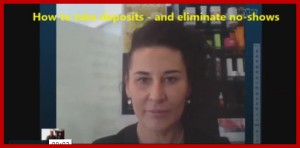
Are no-shows costing you a fortune? Terrified of taking deposits?
Lots of our Members have faced, and solved this precise problem. Before Kim Susskind (Ebony Beauty, Noosa) took action and implemented a deposit policy, no-shows were running at 20 a month. Now, they’re down to…three!
In this video, Kim reveals the fear she and her staff had to overcome – and the letter she gives to clients that clearly sets out her deposit and cancellation policy.
This might just be the most important few paragraphs you read this week, this month, or even this year.
It was sparked by a converstion with a brand new WSM member, who called shortly after the courier knocked on her door to hand over her Essential Salon Owner’s Marketing Toolkit®
This salon owner was clearly overwhelmed by the task ahead of her. “There’s so much material in the Toolkit, I just can’t get my head around what to do first,” she wailed.
(My immediate thought, left unsaid, was ‘maybe we’re giving Members too much material’. But then, how do you eat an elephant? Same way you eat a hamburger, one bite at a time.)
So I told her to take a deep breath, and took her through the only THREE things she needs to concentrate on. “Once you GET this,” I said, “everything else becomes easy, logical, simple.”
When we take on a new Member salon into our flagship marketing & mentoring program, My Social Salon, we work on three main areas, and here they are:
1) MESSAGE
2) MARKET
3) MEDIA
First, under Message: what do you say to your past, present and future prospects, customers and clients that is magnetic… that cannot be ignored…that must be responded to. In other words, what is your
USP – Unique Selling Proposition
Most salon business people – and this applies even MORE to big, dumb companies who pay advertising agencies a fortune in shareholders money – make the mistake of believing that some cutesy slogan is their USP.
Eg., here are some slogans used by three of America’s biggest advertisers:
1. We’re with you.
2. That was easy
3. The stuff of life.
Do these bring instantly to mind the name of the company? Nope, vague, meaningless drivel, all three of ’em.
Here’s what’s instructive: these slogans could be used by almost any company on the planet, with about as little impact. As Dan Kennedy writes in a recent article “…if anybody and everybody can use your USP, it ain’t one…”
I’d be a rich man indeed if I had a buck for every time a salon owner told me “Our USP is ‘we give our clients great service’….”
Put your USP through this test: is it a GREAT answer to the question, ‘why should I do business with YOUR salon as against any of the others?’
If not, go back to the drawing board. Take some of the truly great USPs as a model, lay them down next to your USP, see how they compare.
Does yours do for your business what Tom Monaghan’s did for Dominos Pizza? “Fresh, Hot Pizza Delivered in 30 Minutes – Guaranteed”…?
Does it answer the question like Federal Express answered with “Absolutely, Positively Overnight.”
Let’s say you’ve crafted a great message with a terrific USP at its core, next problem: your MARKET.
Who do you deliver that great message to – and deliberately, who do you exclude from it – do you do that effectively, efficiently with little or no manual labour, are you smart about this or are you simply throwing mud against the wall?
When asked ‘Who’s your target market?’ most salon owners will say ‘Er, all of the adult female population within a 5 mile radius.’
Terrific. If you want to send a postcard once a year to all adult females within a 5 mile radius of your salon – hardly an intense, focussed campaign – what’s your budget have to be? Um, $50,000. How much have you got? ‘Uh…600 bucks.’
Problem. Somehow, preferably by science, you have to shrink your target market to a small, carefully-selected list of the best prospects so that your marketing efforts are concentrated for maximum effect with minimum expense. Jump up and down in a puddle, not the ocean.
And third, the MEDIA.
Having chosen your target market and crafted the perfect message to that target market, what MEDIA are you going to use to deliver that message to that market?
(If you haven’t twigged to this already, once you’ve figured out your perfect target market, and the message to send to it, the media tends to choose itself).
So there.
That’s it in simple terms. Message, Market, Media.
Get those things right, the rest almost automatically falls into place.


 by Greg Milner, CEO Worldwide Salon Marketing

 Are no-shows costing you a fortune? Terrified of taking deposits?


